What began as an ordinary construction project quickly turned into one of the most extraordinary discoveries the city had ever seen.
A crew of construction workers was laying the foundation for a new apartment building when their equipment struck something solid—far more solid than bedrock. Beneath layers of dirt and debris lay a stone wall, weathered and ancient, suggesting it had been untouched for generations. No such structure appeared on any underground maps or historical records.
Curiosity outweighed caution.
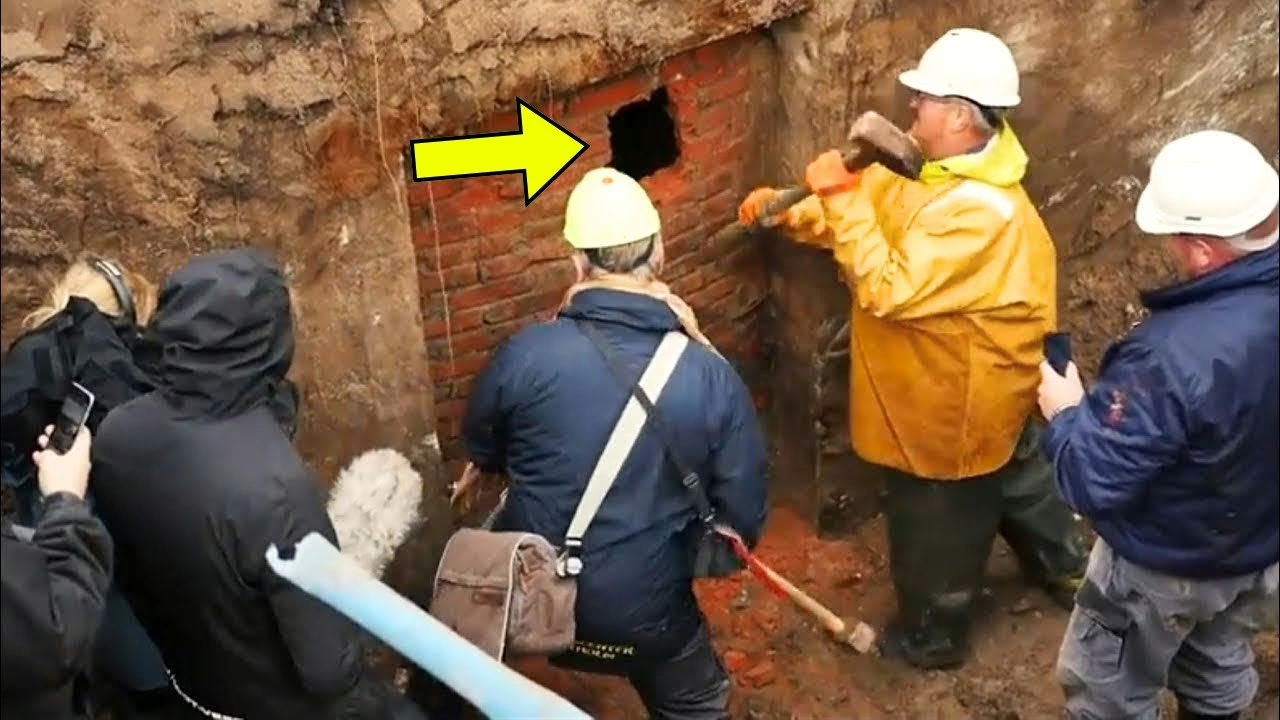
When the workers broke through the stone barrier and shone their torches inside, the color drained from their faces. Whatever lay beyond was not meant to be found.

An Unexpected Discovery
Jorah, the crew’s captain, stepped forward first. Responsible for the project and its progress, he felt compelled to assess the situation himself. Any unknown underground structure could halt construction indefinitely.
Beyond the broken stone wall was a vast room—far larger than anyone expected. It wasn’t a basement. It wasn’t a panic room. No buildings had ever existed on this land before. The craftsmanship alone suggested advanced planning and expertise.
As Jorah swept his flashlight across the walls, he noticed something unsettling: intricate symbols carved into the stone. They were unlike any language he recognized—neither modern nor familiar. The markings were precise, deliberate, and unmistakably ancient.
The room was empty, save for a single, heavy door at the far end. Its lock was rusted with age, as though it had not been touched in decades—perhaps centuries.
Jorah tried the door but stopped himself before forcing it open. Whatever this place was, it wasn’t something to be handled recklessly.
He made the decision to seal the room again.
Obsession Takes Hold
Once back on the surface, Jorah couldn’t shake the image of the symbols. Construction came to a halt, and his priorities shifted completely. What had once been a job defined by schedules and budgets became a personal mission to uncover the truth.
Night after night, Jorah studied the photographs he had taken. His home transformed into a research space filled with books on ancient scripts, forgotten civilizations, and obscure languages. Each symbol seemed to whisper fragments of a story from a long-lost era.
He contacted historians, linguists, and cultural experts. Discussions stretched late into the night as theories were debated and discarded. Though no one could immediately identify the language, all agreed on one thing—it was rare.
Painstaking comparisons with ancient texts began to yield results.
A Language Almost Lost
Gradually, patterns emerged.
The symbols were part of an almost extinct language, referenced only in the most obscure academic records. A language spoken by a civilization long erased from mainstream history. As translations took shape, it became clear the markings were not decorative—they told a story.
Or rather, they gave instructions.
Hidden within the text were references to a key—an object of great importance, concealed somewhere within the city. The symbols suggested the key was essential to unlocking the room and understanding its true purpose.
Jorah knew then that the bunker was only the beginning.
The Hunt for the Key
Armed with maps, historical records, and partial translations, Jorah began tracing the clues through the city. Forgotten alleys, ancient courtyards, overlooked landmarks—each location held fragments of the past.
He searched public archives, interviewed longtime residents, and sifted through dusty manuscripts. Progress was slow, riddled with dead ends and misleading leads. Bureaucratic hurdles tested his patience, but his determination never wavered.
Eventually, a hidden message within the symbols pointed him toward an old estate on the outskirts of the city.
The Forgotten Estate
The estate was once grand, now decaying under the weight of time. Inside, Jorah discovered an abandoned library—a trove of ancient books and manuscripts left untouched for decades.
There, buried among the texts, were references to a mysterious millionaire.
This enigmatic figure had been wealthy, eccentric, and obsessed with ancient cultures. He traveled extensively, collecting artifacts and knowledge from civilizations long forgotten. Slowly, Jorah realized that the bunker—and its symbols—were part of the millionaire’s legacy.
Hidden behind a concealed compartment in the library, Jorah found what he had been searching for.
An ornate antique key.
Its design matched the descriptions embedded in the symbols perfectly.
Unlocking the Past
As news of the discovery spread, public fascination exploded. Media outlets descended on the construction site. Historians, scholars, and cultural experts weighed in with theories. Despite growing pressure, Jorah insisted on a careful, preservation-first approach.
Security was tightened. Experts were consulted.
When the day finally arrived, Jorah stood before the sealed door, key in hand, surrounded by historians and onlookers. As the lock turned, silence fell.
The door creaked open.
Inside was a vault of history.
Shelves overflowed with artifacts, scrolls, coins, and relics spanning centuries. But among them was something even more revealing—a diary written by the millionaire himself.
A Legacy Preserved
The diary told the full story.
The bunker had been created as a sanctuary, a private museum meant to protect cultural treasures from a world the millionaire believed was careless with history. He feared these relics would be lost, destroyed, or forgotten.
So he hid them.
Jorah’s discovery became a national sensation. Museums and institutions rushed to study the artifacts. The city embraced its newly uncovered past, and Jorah was hailed as an accidental guardian of history.
Yet in quiet moments, he reflected on how easily the bunker could have remained hidden forever.
Beneath modern streets and construction sites, the past still waits—silent, patient, and full of stories—until someone is willing to listen.